Responsible AI Music
Ensuring the Future of Music Creation aligns with Trustworthy AI Principles
Generative AI is radically changing the creative arts, transforming the way we create and interact with cultural artefacts.
While offering unprecedented opportunities for artistic expression, this technology also raises ethical, societal, and legal concerns. Key among these are the potential displacement of human creativity, copyright infringement stemming from vast training datasets, and the lack of transparency, explainability, and fairness mechanisms. In response to this, a coalition of organisations representing creative industries formed the Human Artistry Campaign, advocating on behalf of the responsible use of creative AI. As generative systems become pervasive in this domain, responsible design is crucial.
Responsible AI Music (RAIM) is a collaborative initiative bringing together musicians, AI experts, ethicists, and legal experts to define, expand, and monitor requirements for generative music AI. Our goal is to work towards a framework providing guidance on the responsible development and use of generative models and system for music. By balancing innovation with ethical considerations, we advocate for a tradeoff where artists and AI development collaborate in a way that safeguards, inspires, and augments human creativity and artistry.
Can this be done by leveraging a Trustworthy AI framework? This initiative takes a holistic approach, harmonising previous work that has tackled specific aspects of generative systems (e.g., transparency, evaluation, data), within the Ethics Guidelines for Trustworthy AI produced by the European Commission - a framework for designing responsible AI systems across 7 macro requirements. Focusing on generative music AI, we illustrate how these requirements can be contextualised for the field, addressing trustworthiness across multiple dimensions and integrating insights from the existing literature.
What is Trustworthy AI?
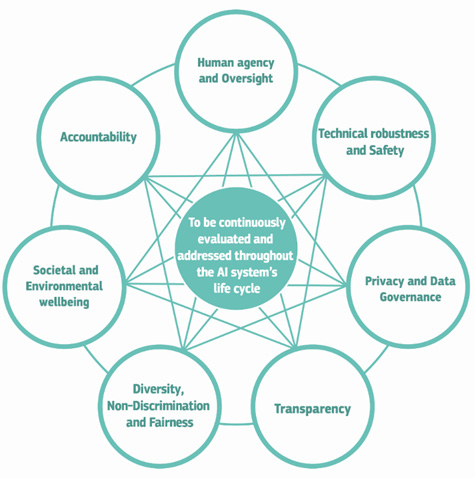
Trustworthy AI encompasses artificial intelligence systems designed and implemented to adhere to fundamental ethical principles, technical robustness, and legal compliance. A referential work in this domain are the Ethics Guidelines for Trustworthy Artificial Intelligence, a document prepared by the High-Level Expert Group on Artificial Intelligence, an independent expert group appointed by the European Commission in 2018.
The guidelines include 7 key requirements that AI systems should meet to be trustworthy:
- Human agency and oversight
- Robustness and safety
- Privacy and data governance
- Transparency
- Diversity, non-discrimination, fairness
- Societal and environmental wellbeing
- Accountability
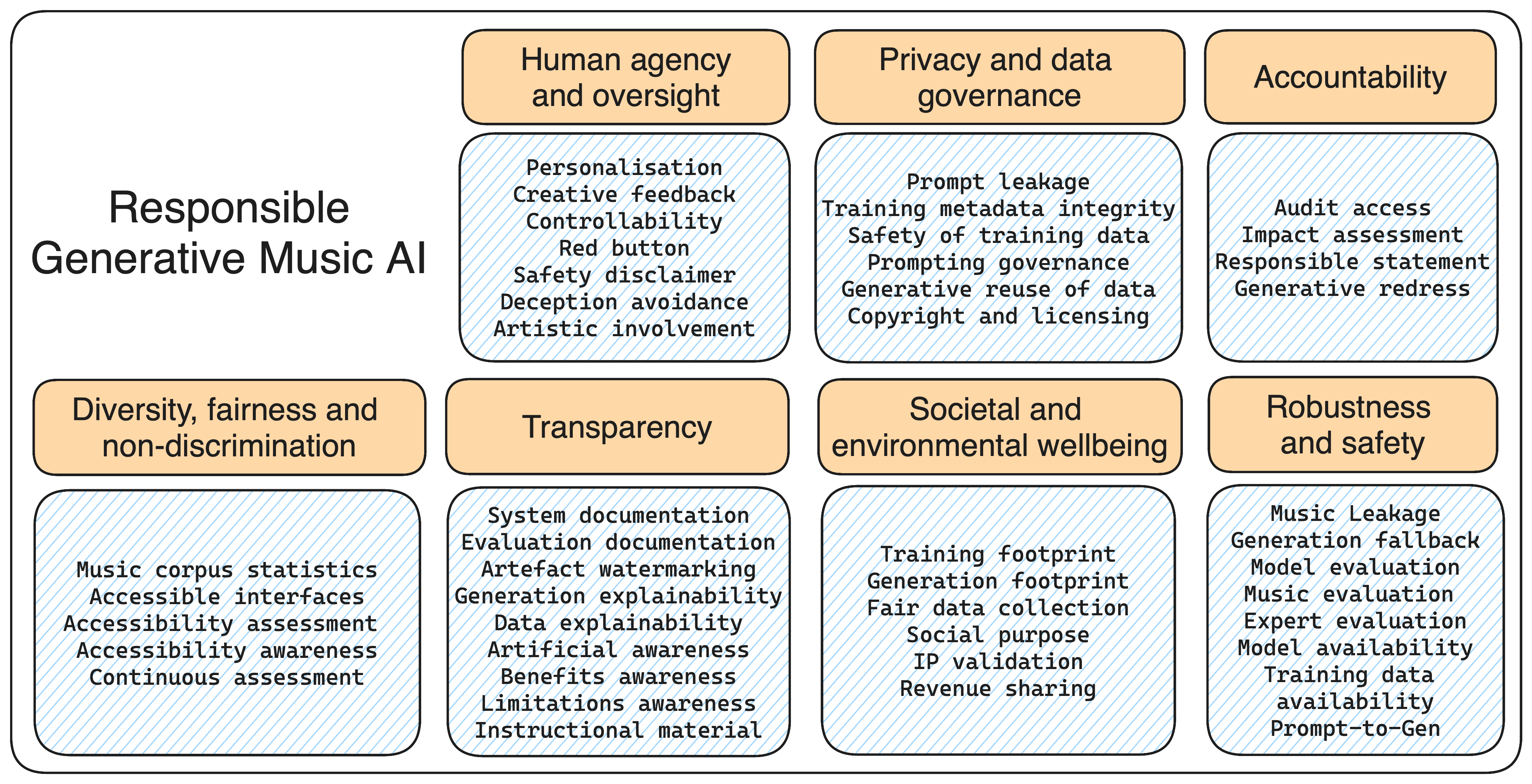
Guiding features for Responsible AI Music
We contextualise the Trustworthy AI framework to the domain of Generative AI Music, by defining responsible features that can drive the design and the evaluation of generative systems, in accordance with the literature.
Before presenting each feature, let's start by introducing some jargon. When referring to Music AIs, a distinction needs to be made between music model and generative music system.
- A music model can be defined as an algorithmic procedure that either encodes a set of rules explicitly, or learns them from the data and the task it is provided. These rules, e.g., a probability distribution for predicting the next note or chord in a piece, or a set of logical statements, can be used to generate, complete, or manipulate music.
- A generative music system encompasses the whole computational infrastructure built on top of a music model to enable users to interact with the model and make use of its outputs, without the need of its inner workings. This includes both technical and the regulatory aspects, such as the interface, the logic which abstract or hide certain parameters of the model, the way the model's predictions are consumed; but also the data management system, the legal framework regulating the exchange of data, etc.
Typically, a generative system is implemented in such a way as to conveniently wrap the functionalities of a particular model, meaning that a model can provide the computational backbone to various generative systems (e.g., plugins for music editors, production environments, smart instruments). For example, MusicVAE has been reused in different applications, such as Beat Blender, Melody Mixer, Latent Loops, and is also available through Magenta Studio, a plugin for the DAW Ableton Live. The distinction between model and system is a peculiar aspect to Generative AI, as their design and implementation involve different stakeholders, such as machine learning engineers and mathematicians for the former, and UX designers, software developers, data engineers for the latter, but also share music experts as a common denominator driving the evaluation efforts.
Discover all features below or jump to those belonging to a specific Trustworthy AI pillar.
Call for action
How to get involved
We actively seek insights and views from AI researchers, ethicists, legal experts, and music professionals to ensure continuous refinement and responsible expansion of generative AI technologies in the music industry. We warmly welcome policymakers, music industry stakeholders, and civil society organizations to join us in this crucial dialogue. Your voice is invaluable in shaping the ongoing discourse surrounding the broader implications of generative AI for all creative industries. There are different avenues to contribute to the initiative. Here are some suggestions:
Contribute to the RAIM framework & join our study
We are building a network of experts who can provide advice and support on responsible AI music. This could involve participating in online forums, or attending our events. Share your insights and experiences, and help inform the next generation of AI Music systems. We are soon launching a study to assess the importance of each feature relative to each stakeholder group, leading to the definition of the framework. To register your interest in participating, please click the button below to send us an email. We will contact you with further details once the study commences and all protocols are in place.
Register Your Interest
Reach out and collaborate with us
If you are interested in working with us, please get in touch! We are actively seeking collaborations to drive the implementation of the RAIM framework. Join us in promoting the next generation of AI music systems that prioritise ethical considerations and adhere to responsible features. Let's work together to establish benchmarks, develop databases and tools, and explore innovative solutions for RAIM.
Reach Out
Share the initiative
Help us spread the word about the RAIM Initiative. Become an advocate and raise awareness about the potential of generative AI in music and the importance of responsible innovation. Share our website and social media channels with your network, or writing about us in your publications.
Together, we aim to foster a vibrant and inclusive ecosystem where generative AI truly empowers musicians and enriches the musical landscape for everyone.